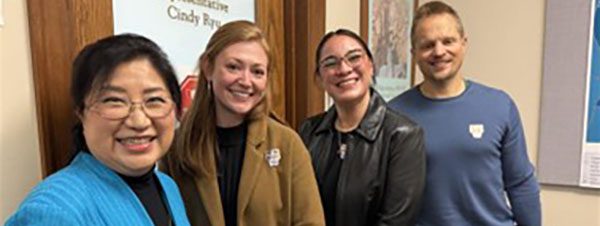
On January 20, 2026 advocates from across Washington gathered in Olympia for Fix the Bricks Lobby Day to support HB 1810, legislation focused on advancing life-saving earthquake retrofits for unreinforced masonry (URM) buildings. The day reflected a strong and growing partnership between the Washington Chapter of the American Institute of Architects, Historic South Downtown, and local government leaders committed to protecting lives, preserving historic places, and strengthening community resilience.
Throughout the day, advocates met with legislators to underscore the urgent need to address the seismic vulnerability of URMs — particularly in historic downtowns that are central to local identity and economic vitality. Conversations centered on the importance of funding a study to develop financial incentives that would make URM retrofits more affordable and achievable for building owners. While no funding decisions have been finalized, there is cautious optimism that the Legislature recognizes both the risk and the opportunity ahead.
This work comes at a meaningful moment. February marks the 25th anniversary of the Nisqually earthquake, a powerful reminder that damaging earthquakes are not a distant possibility but a lived reality in our region. As that anniversary approaches, we encourage readers to reflect on what we’ve learned, and what remains to be done. Stay tuned for additional information about an upcoming Nisqually Earthquake Commemoration event focused on public awareness, resilience, and action. This event is tentatively scheduled for the evening of February 26 at Seattle City Hall.
Community conversations continue beyond the Capitol as well. Earlier this month, the Museum of History and Industry History Café brought together the Chehalis Tribe, the Pacific Northwest Seismic Network, Historic South Downtown, and the City of Seattle for a rich discussion on earthquakes, history, and place. The event highlighted how science, lived experience, and historic preservation intersect, and why investment in risk reduction is essential as we prepare for inevitable future earthquakes.
As we look ahead, the message is clear: earthquakes do not wait for policy timelines, funding cycles, or studies to conclude. To protect lives and preserve the places that define our communities, we must move faster than geology and act now to reduce risk before the next earthquake reminds us why this work matters.