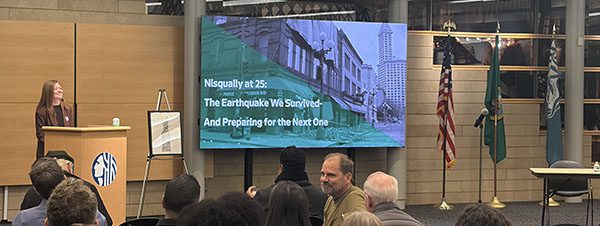
On February 28, 2001, the Nisqually earthquake shook the Puget Sound region to its core. Twenty-five years later, on February 26, 2026, experts in seismology, emergency management, structural engineering, and public policy revisited that moment — grounding the conversation in lived experience while challenging nearly 100 attendees to rethink how we prepare for the next one. The evening was filmed by the Seattle Channel and will be shared to their Youtube Channel and website. Panelists and presenters included:
- Ryan Molenkamp, artist, exhibited selections from Fear of Earthquakes, his acclaimed series capturing the emotional weight of living with seismic uncertainty.
- Brian Surratt, Seattle Deputy Mayor, delivered opening remarks on the City’s resilience efforts and the path forward. recounting his memories of the earthquake working in an unreinforced masonry (URM) building in Pioneer Square and admitted to running from the building during the shaking. The proper response during shaking is to Drop, Cover, and Hold: drop to the floor, find cover under a desk, table or other sturdy furniture, and hold on.
- Harold Tobin, Director of the Pacific Northwest Seismic Network, discussed the science of the Nisqually earthquake and what we now understand about the region’s seismic risks. He emphasized the importance of early warning systems and their role in providing critical seconds of advanced notification before heavy shaking starts.
- Jon Siu, Seattle’s Principal Engineer during the quake, recounted building damage, closures, and critical lessons learned. At the time, the Emergency Operations Center was housed in the basement of an unreinforced masonry (URM) building, which was severely damaged and limited entry hampered the immediate response. The city’s new Emergency Operations Center opened in 2010 as a state of the art hub for coordinating local, state, and federal response during a disaster.
- Jim Mullen, Seattle’s Emergency Manager during Nisqually and former Director of Washington State Emergency Management, spoke via recording about leading emergency operations that day and the long-term challenges of statewide preparedness. He stressed that interdepartmental and agency cooperation is imperative when responding to any natural disaster, but the local response is the most important, stating: “Federal assistance is icing on the cake, but that cake needs to be baked by local government.”
- Kyle Steuck, President of the Washington Chapter of the Earthquake Engineering Research Institute, connected Seattle’s risks to global earthquake losses and highlighted what modern engineering tells us must still be retrofitted. Similar earthquakes in Mexico City showed that building collapse can indeed be dangerous and life threatening, but the resilience of the local community plays an important role in the recovery after the shaking stops.
- Amanda Hertzfeld, Seattle URM Program Manager, provided updates on the City’s recent retrofit efforts and explained why state-level action remains urgent. Though disheartened by the failure of House Bill 1810 passage in the state legislature she reinforced that URM retrofitting remains a priority in Seattle.
This year’s event followed the Mayor’s official Proclamation declaring February 28, 2026, as Nisqually Earthquake Commemoration Day, calling upon residents, businesses, labor partners, and institutions to reflect on the lessons of the past; support seismic safety initiatives; advance the retrofitting of vulnerable buildings; and commit to identifying and addressing additional seismic risks for all who live in, work in, and visit Seattle.
The Nisqually earthquake caused widespread damage but occurred deep underground and south of Seattle, sparing the city from the devastation that a larger or closer event could bring. Experts warn that the next major earthquake may not be as forgiving. This anniversary is not just about remembering, it’s about what we choose to do now — before the next quake makes the decision for us.