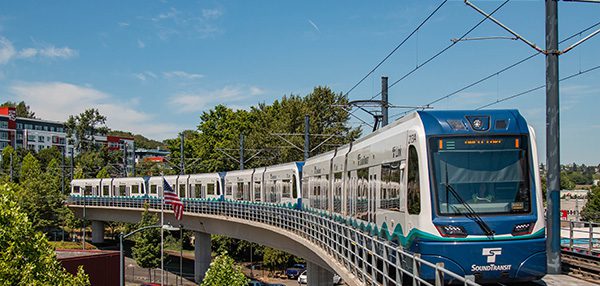
Current Land Use Code regulations provide for reduced parking within Frequent Transit Service Areas. Legislation related to the new State law recently went into effect. The law reduces parking and allows increased housing density on lots located near a new designation, Major Transit Stops.
Layers corresponding to these areas are included in the City’s GIS Map, available at: City of Seattle GIS Map
Here are the main differences between these two designations:
Frequent Transit Service Area:
Frequent Transit Service Area means an area within 1,320 feet walking distance of a bus stop served by a frequent transit route or an area within 2,640 feet walking distance of a rail transit station, as shown on a map adopted by Director’s Rule 3-2023. The code allows for parking reductions when a lot is within the mapped Frequent Transit Service Area.
- Existing parking reductions in the code will continue. Also, no parking is required for a congregate residence (Table B for SMC 23.54.015) within ½ mile of a Frequent Transit Service Area.
Major Transit Stop
Major Transit Stop means:
- Stops on a bus route operated by Sound Transit
- Commuter rail stops
- Stops on light rail, street car, or trolley bus systems
- Stops on bus rapid transit routes
- Any future stop on a bus rapid transit route funded for development and projected for construction within an applicable 6-year transit plan under RCW 35.58.2795
The code allows for increased density and parking reductions when a lot is within a specified distance to a Major Transit Stop.
- Properties are allowed up to 6 units (SMC 23.44.017) if they are within ¼ mile of a major transit stop.
- No parking is required for a congregate residence (Table B for SMC 23.54.015) within ½ mile of a Major Transit Stop.
- Parking is not required for all middle housing types (Table B for SMC 23.54.015) within ½ mile of a Major Transit Stop.
Middle housing means any of the following residential uses, provided that they are located in structures that do not exceed a height limit of 32 feet not including roofs or rooftop features allowed in the underlying zone, as measured in Section 23.86.006:
- Accessory dwelling unit
- Adult family home
- Apartment
- Carriage house
- Congregate residence
- Cottage housing development
- Low-income housing
- Mobile home
- Multifamily residential use
- Permanent supportive housing
- Rowhouse development
- Single-family dwelling unit